Data catalog
This catalog organizes data the way a planner encounters it in the platform: records that provide context, observed events, process configuration, and planning results.
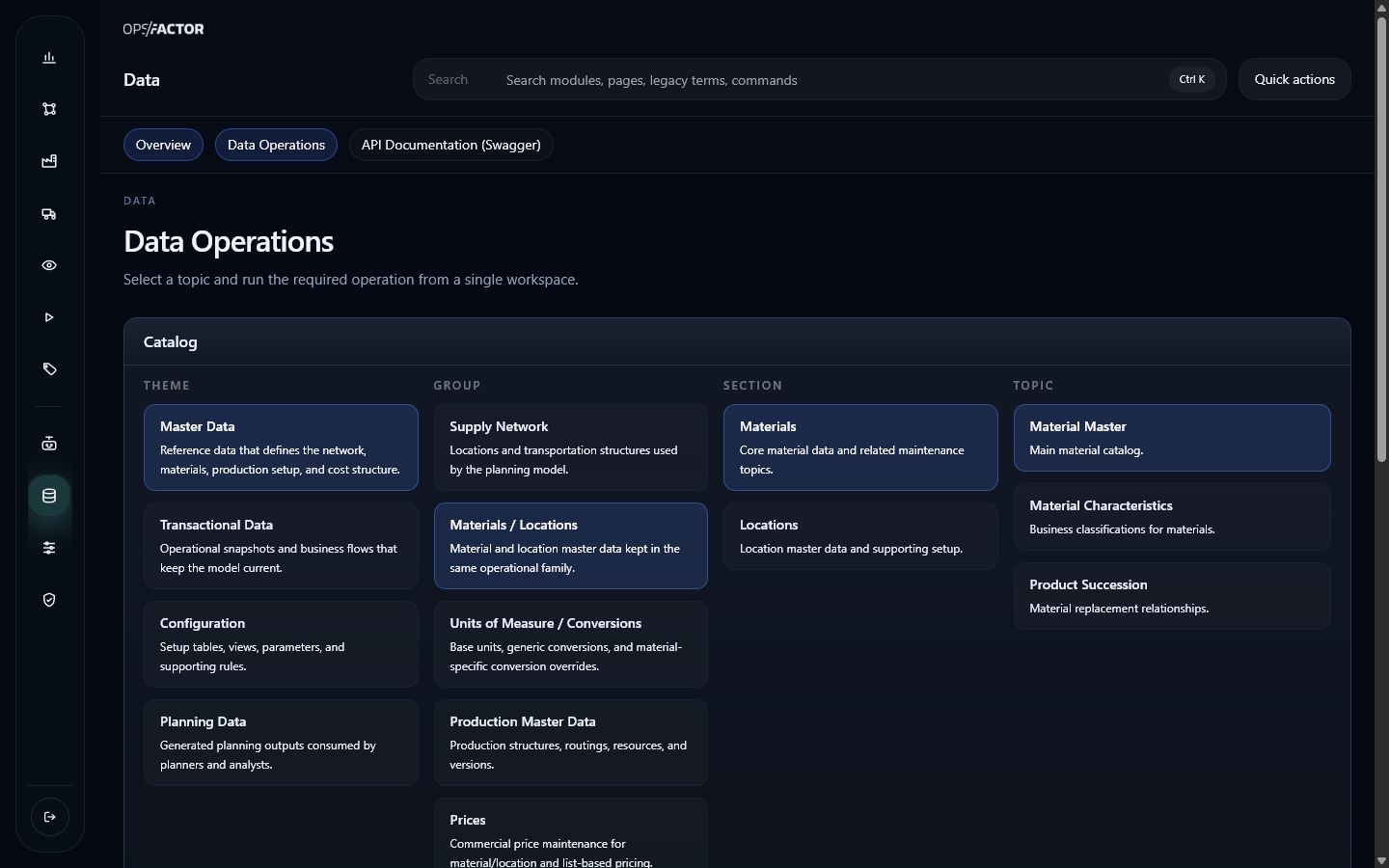
Under Data > Data Operations, select the theme first, then move through group, section, and topic. The highlighted selection shows Master Data > Materials / Locations > Materials > Material Master.
Structure by theme
| Theme | What it contains | Available examples |
|---|---|---|
| Master data | Records reused by multiple processes | Materials, locations, units, prices, COGS, network, and production |
| Transactional data | Events and states observed in the operation | Sales, inventory positions, orders, deliveries, firm production, and vehicle loads |
| Configuration data | Rules that determine how planning runs | Demand Planning, Supply Planning, and inventory policies |
| Planning data | Projections, versions, and future decisions | Demand Plan and Supply Plan |
| Enumerated Values | Accepted values for selection fields | Location types, lifecycle stages, sources, and buckets |
The Demand Planning data model crosses all four themes from sales history to collaborative forecast. The Supply Planning data model connects demand, inventory, orders, network, production, policies, configuration, and the versioned Supply Plan. The economic decision data model continues from those physical facts to inventory-policy economics, P&L facts, propagated costs, contribution, and plan comparison.
Page structure
Each page covers business meaning, granularity and key, required fields, optional fields and their defaults, the path in the platform, dependencies, a complete list of uses within the documented scope, and validations.
The pages use planning language. Technical terms appear only when they match a field name or help complete a task. This structure supports people, search, MCP access, and future agents.
Required fields and default values
Required status is always identified through dedicated sections or an explicit column. Required fields do not have a default value and must be provided. The Default Value When Not Provided column appears only for optional fields and states the exact value used by the platform. Completion guidance and validation rules remain outside that column.
Conceptual and versioned contracts
These pages describe the current functional contract. Endpoints, file formats, and edition availability may change. The deployed version's OpenAPI specification is the final payload reference.