S&OE and Line Sequencing
S&OE converts tactical priorities into near-term operating decisions. Line Sequencing answers not only how much to produce, but on which resource, in what order, in which time window, and for which customer priority.
Path in the platform
Production → Line Scheduling
From aggregate capacity to a sequence
The Supply Plan establishes required production by period. The sequence expands that requirement into jobs with start and end times. It must reconcile:
- eligible production versions, routings, and resources;
- resource calendars, shifts, maintenance, and unavailability;
- firm and planned production orders;
- lot size, minimum quantity, multiples, and campaign rules;
- setup time and sequence-dependent changeovers;
- material availability and multi-stage dependencies;
- due dates, customer priority, service, and profitability objectives.
A resource may have enough monthly hours and still be unable to execute the proposed mix because setups, windows, component timing, or job order make the detailed schedule infeasible.
Optimization and decision objectives
Detailed sequencing is a combinatorial optimization problem. Enterprise uses models designed to search the large number of possible assignments and orders while respecting hard restrictions and comparing softer objectives.
The objective can prioritize profitability, customer service, lateness, throughput, adherence to the tactical plan, utilization, or setup reduction. Customer priority can influence which orders remain protected when all demand cannot be produced in the available window. The objective and its weights must be agreed before comparing schedules; otherwise a technically valid sequence may optimize the wrong business outcome.
Lots, shelf life, and projected write-off
In sectors where shelf life is relevant, S&OE can consider the remaining life of each lot. Lots closer to expiry may be consumed or moved earlier, or assigned to markets with shorter transit and consumption time. The same projection can expose inventory that is likely to expire and estimate future write-off.
Shelf life is an optional industry-specific layer, not the definition of S&OE. For durable products, the core remains finite capacity, setup, material availability, due dates, and service priorities.
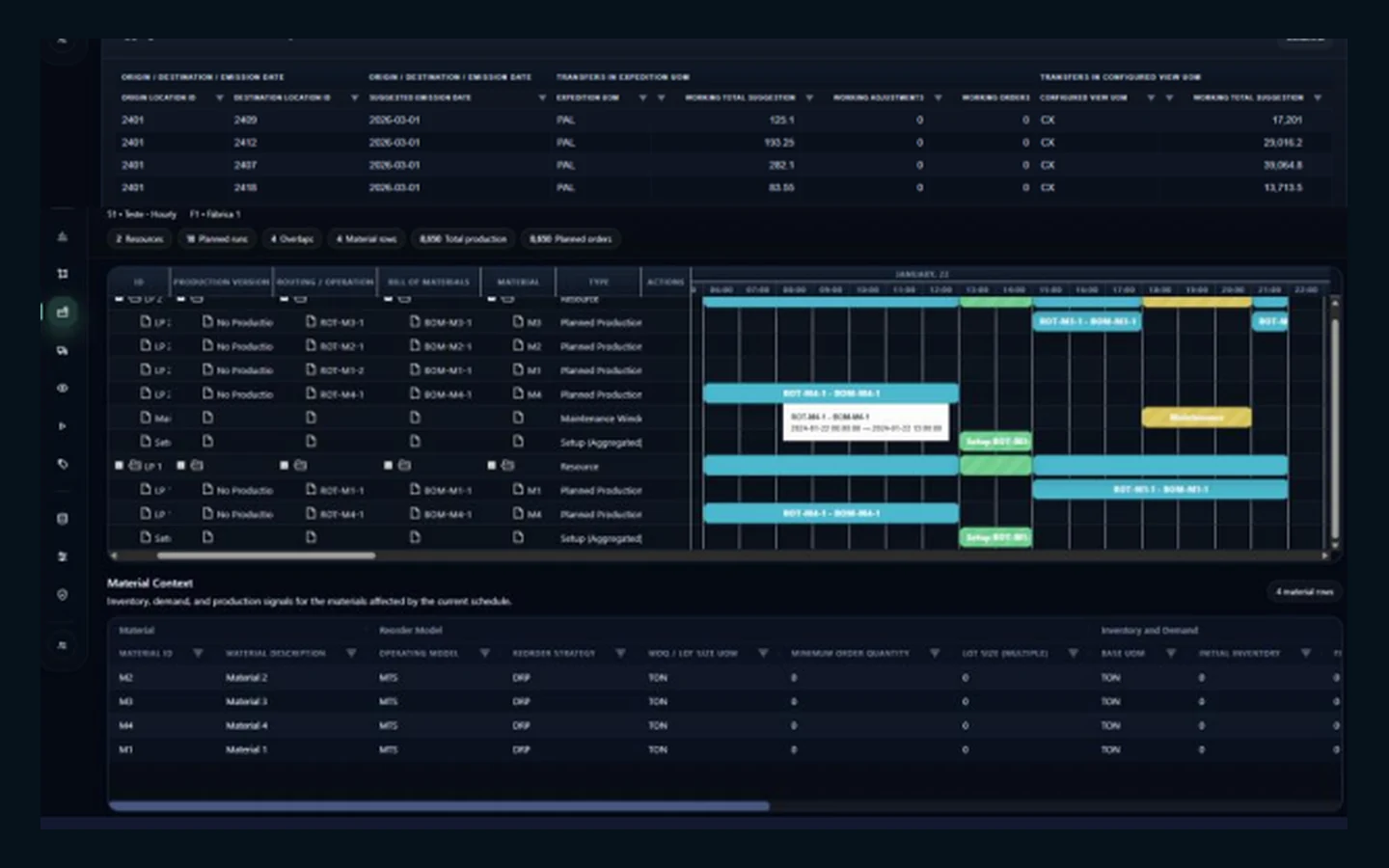
How to read the Gantt
- each parent row is a production resource;
- firm production represents commitments that are not free planning adjustments;
- planned production can still be assigned or moved within viable alternatives;
- maintenance and unavailability block time windows;
- setups show transitions between products or families;
- overlaps, late jobs, and unallocated orders expose conflicts.
Always read the Gantt with inventory, demand, and dependent materials. Moving an order may resolve a resource conflict and create a component shortage or customer delay elsewhere.
Recommended journey
- Select the production location and the Supply Plan.
- Confirm the sequencing horizon, resources, shifts, and frozen window.
- Treat firm orders, maintenance, and unavailability as commitments.
- Validate production versions, routings, BOMs, processing times, lots, and setups.
- Choose the objective and customer-priority rules.
- Generate and compare feasible sequences.
- Review lateness, setups, utilization, material availability, and shelf-life exceptions when applicable.
- Approve the sequence or return structural gaps to Supply Planning.
Constrained and unconstrained reading
An unconstrained requirement shows what should be produced to serve demand. The constrained schedule shows what can be placed in actual resources and windows. The difference must identify the affected sale, the binding resource or material, and the additional capacity, shift, alternate resource, or lead-time reduction needed for full service.
A local manual move does not replace replanning when demand, capacity, routing, network, or material availability changes structurally.
Data connections
- Production resources and routings
- Bills of material and production versions
- Production orders
- Planning calendar, working days, and holidays
- Production costs
- Supply Plan
Edition comparison
| Capability | Community | Pro / Enterprise |
|---|---|---|
| Aggregate production Planning Book | Included; capacity hours and planned production by period | Included with advanced analytics and governance |
| Manual adjustment of the Working Plan | Included for planned production quantities | Included with richer collaboration and controls |
| Detailed finite-capacity Gantt | Not included | Enterprise |
| Combinatorial sequence optimization | Not included | Enterprise; resource assignment and order sequencing |
| Setup, maintenance, shifts, and temporal tasks | Not included in detailed form | Enterprise |
| Profitability, service, and customer-priority objectives | Not included as a sequencing optimizer | Enterprise |
| Lot shelf life and projected write-off in execution | Not included | Enterprise when the industry model requires it |
Community supports the aggregate production decision; detailed temporal scheduling and sequencing remain Enterprise.