DRP, Deployment, and load formation
DRP converts demand, inventory, and replenishment policies into transfer requirements between origins and destinations. Its central decision is how to deploy available supply across customers and locations while preserving service priorities and executable logistics.
Path in the platform
- Distribution → DRP Parametrization
- Distribution → Deployment
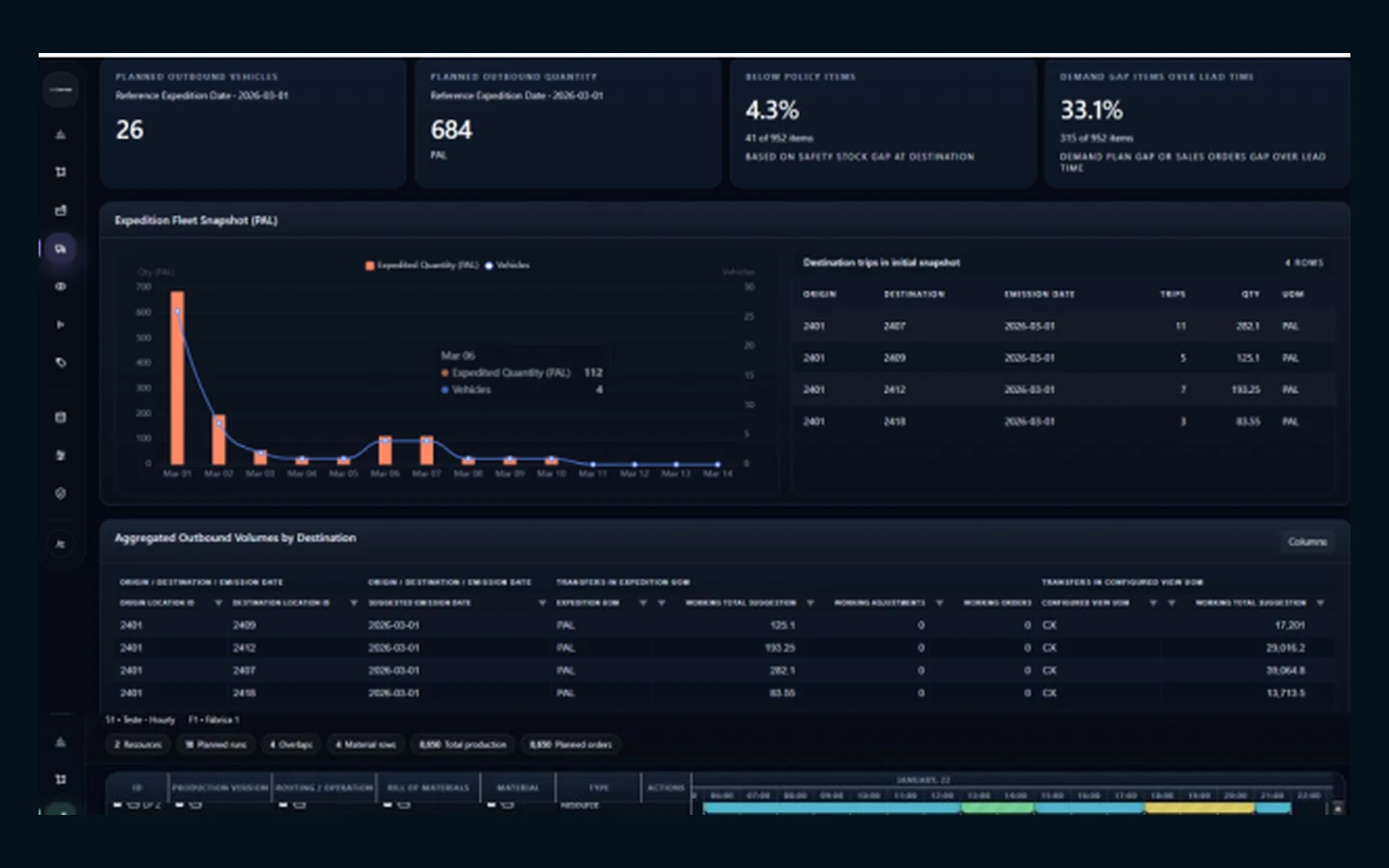
Requirements, deployment, and loads are different objects
- A distribution requirement is the quantity and date needed at a destination.
- A planned transfer assigns an origin, shipment date, receipt date, and quantity.
- Deployment is the operating workspace where planned inbound can be reviewed or adjusted.
- A load order groups compatible transfers into an executable vehicle movement.
Keeping these objects separate prevents a planning suggestion from being confused with a logistics commitment.
Customer priority and fair share
When supply is insufficient, DRP must define how shortage is shared. A single proportional rule is not always adequate. Prioritization may consider customer class, service commitment, channel, order age, destination criticality, product, or economic contribution.
Fair share can protect either demand fulfillment or target safety stocks. For example, the model may distribute scarce inventory proportionally to uncovered demand, preserve a minimum service floor across regions, or protect higher-priority customers before allocating the residual. The selected rule must be visible because it explains why two destinations with the same shortage receive different quantities.
Load and vehicle formation
Load formation groups compatible transfers according to route, shipment and receipt windows, vehicle capacity, weight, volume, lot, compatibility, and minimum utilization. The plan may compare different fleet profiles:
- dedicated fleet, with committed capacity and a fixed-cost profile;
- semi-dedicated fleet, with negotiated availability and mixed fixed/variable economics;
- spot market, with flexible capacity and price or availability risk.
The best load is not necessarily the fullest vehicle. It must arrive in time, serve the intended priority, respect the lane and material constraints, and remain economically coherent. The planned output is documented in Consolidated Planned Loading Orders; actual trips are recorded in Vehicle Loading Orders.
Constrained and unconstrained scenarios
An unconstrained DRP shows the transfers required for full service. The constrained scenario applies origin inventory, transport and handling capacity, lead time, eligible lanes, vehicle availability, and prioritization.
The gap should expose:
- destinations and customers affected;
- the exact unmet quantity or delayed sale;
- whether the cause is origin stock, transport, handling, lead time, route, lot, or priority;
- the additional capacity or lead-time reduction required to serve the demand;
- whether another origin or fleet profile is a viable alternative.
Optional shelf-life layer
For perishable or aging-sensitive products, the recommendation can avoid shipping lots that would arrive with insufficient remaining life, move older acceptable lots first, and project future write-off. This is an optional industry-specific layer. The core DRP proposition remains customer prioritization, fair share, deployment, and vehicle formation.
Required inputs
- Supply Plan and Working Plan;
- active origins, destinations, and transportation lanes;
- materials eligible on each lane;
- demand, inventory positions, and inventory policy;
- lead time, minimum lot, multiple, and unit of measure;
- handling capacity, fleet, vehicle type, freight profile, and time windows when load formation is used;
- shelf life, lot aging, and remaining-life rules only when applicable.
Recommended journey
- Confirm destination requirements and projected stock.
- Validate eligible origins, lanes, lead times, and available supply.
- Define customer priority and fair-share policy.
- Generate unconstrained and constrained transfer proposals.
- Explain shortages and test alternate origins or capacity.
- Consolidate compatible transfers into vehicles.
- Review utilization, freight profile, shipping and receipt dates, and sector-specific shelf-life exceptions.
- Release the operating schedule or return the exception for replanning.
Edition comparison
| Capability | Community | Pro / Enterprise |
|---|---|---|
| Heuristic distribution requirements | Included as part of the heuristic Supply Plan | Included with optimization alternatives |
| Operational Deployment | Included for one origin-destination-material flow in the current Working Plan | Multi-item analysis, aggregation, configured views, and advanced workspace |
| Basic network priority | Included through configured network priorities | Advanced customer priority and optimization criteria |
| Fair share across customers or safety stocks | Basic heuristic allocation where supported | Enterprise optimization and advanced policies |
| Load and vehicle formation | Not included | Enterprise; fleet profiles, capacity, consolidation, and cost |
| Constrained/unconstrained comparison | Included at plan level | Advanced causal and economic explainability |
| Shelf life, lot eligibility, and projected write-off | Not included | Enterprise when enabled for the operating model |
Connect the result to Inventory policy and Cost-to-Serve before approving a distribution policy change.