Supply Network Planning and Design
This domain answers two related but distinct questions:
- Network Design: which plants, distribution centers, suppliers, lanes, and capacities should compose the network?
- Supply Planning: how should the available network produce, purchase, transfer, and hold inventory over the tactical horizon?
Keeping the questions separate is important. Network Design changes the structural alternatives; Supply Planning tests how an existing network responds to demand.
Path in the platform
Use Supply Chain Planning → Supply Network Explorer to validate dependencies. Analyze the tactical result in Supply Chain Planning → Planning Book, Supply Plans, or Constraint Tracker.
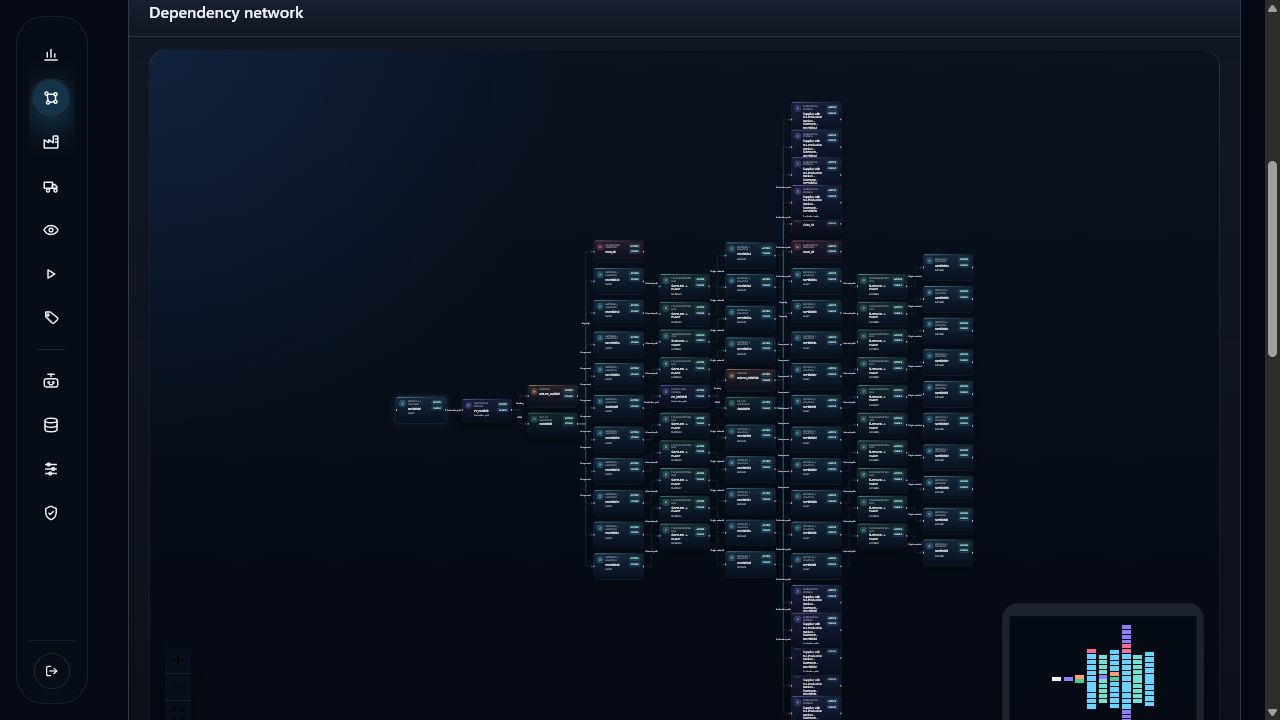
Network Design: brownfield and greenfield
Network Design is an Enterprise optimization capability.
- As-is reproduces the current footprint and establishes a control scenario.
- Brownfield starts from existing assets and commitments, then evaluates which locations, connections, or capacities should change.
- Greenfield can propose candidates and decide which locations should be activated without requiring the current footprint to remain.
Candidate activation and deactivation are solved under a global objective. The comparison may balance fixed logistics costs, first-tier freight, second-tier freight, production cost, raw-material cost, capacity, service, inventory, tax, and margin. A cheaper lane by itself is not necessarily a better network if it shifts cost or restrictions elsewhere.
Every structural scenario must state candidate locations, eligible flows, activation cost or capex, capacity, lead time, service territory, and the economic objective used to compare alternatives.
Execution models
An execution model defines how requirements move through the network and how production, purchases, transfers, and inventory are calculated. Community runs the heuristic model. Pro / Enterprise can also use simultaneous optimization; an Enterprise Process Chain orchestrates steps but is not a calculation engine by itself.
Sequential heuristic
The Community heuristic is a deterministic MPS/MRP and Supply Planning path driven by network dependencies and explicit priorities. It interprets materials, multi-level bills of material, production versions, routings, capacities, lead times, inventory, and open orders to build the three plan series.
The current flow follows this sequence:
- order material–location pairs by low-level code;
- move from demand toward supply sources and generate the Unconstrained Plan baseline;
- level planned production against available productive capacity;
- repropagate components, purchases, and transfers affected by reallocation until the chain converges;
- initialize the Constrained Plan from the same leveled snapshot and apply feasibility cuts;
- update the Working Plan with the series selected by the profile.
The heuristic does not compare every combination under a global objective function. Low-level-code order, production-version and lane priorities, and fair-share rules make the decision reproducible and explainable.
Low-level code
Low-level code is the topological order used to plan a network with distribution and multi-stage production. The ordered unit is a material–location DFU, not the material alone: the same item may occupy different levels at different locations.
Level 1 represents demand at final customers or commercial regions. Subsequent levels move upstream: first the points that supply demand directly, then their logistics origins and the components consumed by bills of material, until the traversal reaches plants, transshipment points, and suppliers. A finished-product requirement is therefore calculated before it generates requirements for its components.
The level number does not represent cost, commercial importance, or fulfillment priority. It represents a calculation dependency. Inactive DFUs are excluded; a cycle in priority lanes or bills of material prevents a finite topological order and causes execution to fail explicitly so the network can be corrected.
Heuristic capacity leveling
In Community, capacity leveling is part of the standard heuristic execution; it is not an editable execution-profile option. It reorganizes planned production inside the Unconstrained Plan before the constrained pass:
- reserve capacity for firm orders and planned quantities outside the current leveling pass;
- try the original production version in the requirement period;
- try other eligible local versions with the same bill of material;
- use build-ahead, moving backward as far as the current period when the required period lacks capacity;
- for the residual, try production origins connected by viable inbound lanes, following each lane's effective priority and lead time;
- when requirements compete for the same resource and period, allocate capacity by fair share;
- keep any residual that could not be reallocated on the original line.
The last step preserves the purpose of the Unconstrained Plan: showing the complete requirement. Capacity guides where and when volume can be produced, but residual volume is neither erased nor prematurely converted into a shortage. The final reduction appears in the Constrained Plan.
When leveling changes a production location or period, the platform traverses the chain again by low-level code. Viable local production is attempted before inbound fallback; only new increments of dependent production consume the capacity ledger again. Passes stop when planned production and inbound no longer change. If the chain does not converge within the limit derived from its depth, execution fails explicitly instead of persisting an unstable plan.
Simultaneous optimization
Pro / Enterprise adds models that can decide production, purchases, transfers, inventory, demand fulfillment, backlog, and structural alternatives together against service or economic objectives. This path is appropriate when sequential priorities are not enough and the decision requires global trade-off comparison.
Multi-stage production
Multi-stage processes are modeled by chaining bills of material and production versions with resources and routings. The platform interprets component dependencies automatically and orders the calculation by production level. The planner does not need to execute one manufacturing stage at a time.
A valid model defines, for every produced material, at least one eligible production version, its bill of material, routing, resource, conversion, lot or multiple, and applicable location.
Unconstrained, constrained, and working plans
- Unconstrained Plan shows the complete requirement before final feasibility cuts. Leveling may reorganize where and when production occurs, but preserves any unallocated residual.
- Constrained Plan applies capacity, inventory, lead time, eligibility, lots, and other active restrictions.
- Working Plan is the operational version selected after execution and may receive approved manual adjustments.
The comparison should identify more than a shortage. For each material-location-period, planners need to understand:
- whether the gap comes from productive capacity, logistics capacity, material, inventory, eligibility, or lead time;
- which customer demand or sale is affected and by how much;
- the additional hours, throughput, storage, transport capacity, or lead-time reduction required to fulfill the demand;
- whether another origin, production version, period, or policy can resolve it.
In Community, constrained results are produced by the heuristic and should not be presented as a global mathematical optimum. Enterprise can compare alternatives simultaneously and provide deeper causal and economic explainability.
Required data
- materials, locations, and units of measure;
- transportation network with versions, lanes, and eligible materials;
- production structure, resources and routings;
- inventory positions, open orders, and the Demand Plan;
- production, storage, inbound, outbound, and transport capacity;
- lead times, lots, multiples, production costs, logistics and location costs, Supply Planning setup, and inventory policies.
The output families are documented in the Supply Plan.
Recommended journey
- Model and reconcile the as-is network.
- Validate lanes, BOMs, routings, resources, production versions, units, and costs.
- Run the Unconstrained Plan, quantify the full requirement, and review the allocation proposed by leveling.
- Run the Constrained Plan and locate gaps.
- Explain the affected demand and required capacity or lead-time change.
- In Enterprise Network Design, define candidates and compare brownfield or greenfield alternatives under a global objective.
- Select the Working Plan and communicate exceptions to S&OE, DRP, inventory, and Finance.
Edition comparison
| Capability | Community | Pro / Enterprise |
|---|---|---|
| Network, BOM, routing, resource, and production-version master data | Included | Included with managed governance and scale |
| Multi-stage MPS/MRP | Included; dependency-aware heuristic calculation | Included; heuristic or optimized execution |
| Productive capacity and lead-time constrained plan | Included through heuristic capacity balancing | Included with simultaneous optimization and advanced restrictions |
| Unconstrained, Constrained, and Working Plans | Included | Included with advanced scenario comparison and explainability |
| Basic production Planning Book | Included with aggregated capacity and Working Plan adjustments | Advanced Planning Books and additional analytical views |
| Brownfield / Greenfield site selection | Not included | Enterprise; optimized candidate activation and deactivation |
| Global network optimization | Not included | Enterprise; flows, production, inventory, service, costs, and margin solved together |
| Detailed Supply Network Flows analysis | Not included | Enterprise read and analytical views |
Continue to S&OE and Line Sequencing for detailed execution or to the manufacturing network case for a reusable scenario process.