Sell-in
Sell-in records a sale where origin and destination are known: which internal unit made the sale and which customer or location received it.
It applies when the served customer is a relevant dimension, including direct channels, billing, identified shipments, and sales from a plant or distribution center to a distributor.
Path in the platform
Data > Data Operations > Transactional Data > Sales / Inventory > Historical Sales > Sales / Sell-in
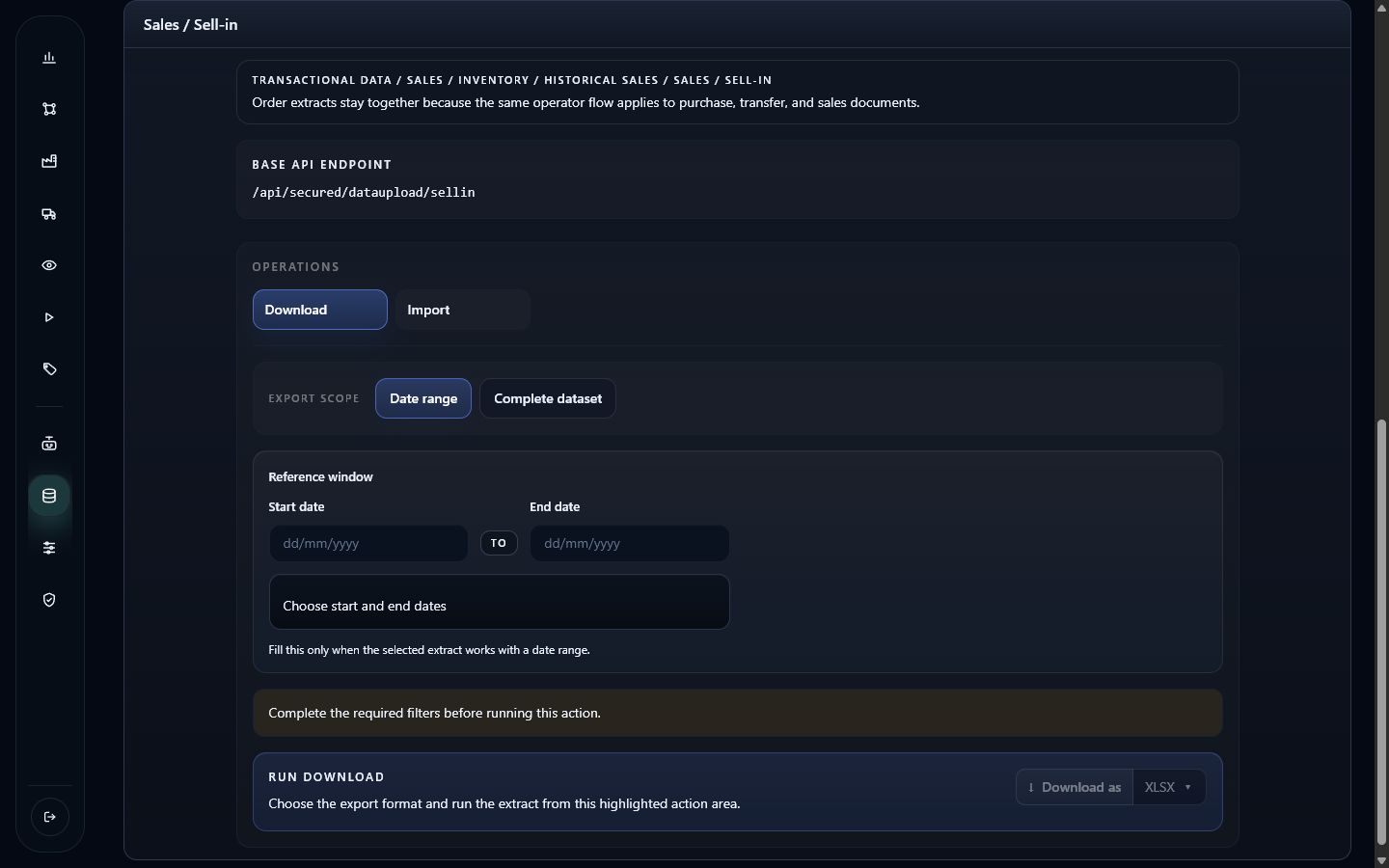
Sell-in follows the same flow: choose a date range or the complete dataset, fill the required filters, and then run the download.
Granularity and identification
- Granularity: one transaction or aggregate by date, origin, destination, material, and unit.
- Identification:
documentIdmust distinguish every loaded row.
documentId may be the source transaction identifier or a stable combination.
For a load consolidated by day, origin, destination, and material, use for
example 2026-05-31|DC-01|CUSTOMER-07|MAT-001. If unit, channel, order,
invoice, or another dimension separates rows, include it in the ID or
consolidate before loading.
For monthly-only processes, the month's total can be loaded on either the first or last day of the month. Consolidation assigns the full value to the monthly bucket without spreading it across days. Choose one convention and preserve it across loads. See Identifiers and periodicity.
Required fields
| Field | Meaning |
|---|---|
documentId |
Unique transaction or aggregate-row identifier |
referenceDate |
Sale date or chosen reference date for the aggregate period |
originLocationId |
Internal unit that made the sale |
destinationLocationId |
Customer or location that received the sale |
materialId |
Material sold |
quantity |
Quantity sold |
Optional fields
| Field | Meaning | Default Value When Not Provided |
|---|---|---|
uomId |
Unit in which quantity is reported | Value from Global Planning Parameters (default there: UN) |
totalValue |
Total sales value | 0 |
discounts |
Associated discounts | 0 |
tax |
Associated taxes | 0 |
cost |
Associated cost | 0 |
When uomId is provided, it must exist in Units of Measure and be convertible to the plan unit.
Dependencies
materialIdreferences Materials.originLocationIdanddestinationLocationIdreference Locations.uomIdreferences Units of Measure or follows Global Planning Parameters.- Source selection uses the Sales History Source enum in the Demand Planning Execution Profile.
Used by
- Demand Planning preparation
- Demand Planning Execution Profile
- Cluster-level AutoFit
- Demand Planning execution
- Demand Plan analysis
Sell-in and sell-out in the same process
A sale from a plant or distribution center to a distributor is sell-in: both the internal origin and distributor location are known. In collaborative planning, the distributor may also share its sell-out and inventory. Its sell-out forecast, combined with current and projected inventory, supports the future sell-in projection required for replenishment.
The sources may also coexist by channel. Do not add them without separating the point in the flow and the scope represented by each series.
Recommended checks
- do not reuse a
documentIdfor different rows; - register materials, locations, and units before loading sales;
- define a clear rule for returns and negative quantities;
- load only closed historical periods;
- reconcile period totals with the source system.